

Pushing the Outer Limits
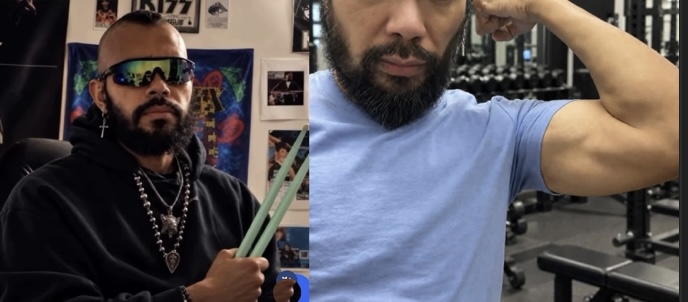
When Musical Speed Becomes a Physical Feat
For multi-instrumentalist Nate Franchesco, speed has increasingly become about something larger than simply playing music fast. In a span of only about six weeks, Franchesco pushed his practice-pad speed through increasingly extreme territory, ultimately reaching his original goal of 600 BPM – and then pushing as high as 650 BPM.
What began as a short-term challenge has evolved into an experiment in physical performance: how far can rapid hand speed, coordination and controlled movement actually be pushed?
Reaching the 600 – 650 BPM range didn’t end the experiment. It changed the question.
Franchesco is now continuing to explore the outer limits, seeing just how far beyond his original goal his hands can go.
From Musician to Human-Performance Experiment
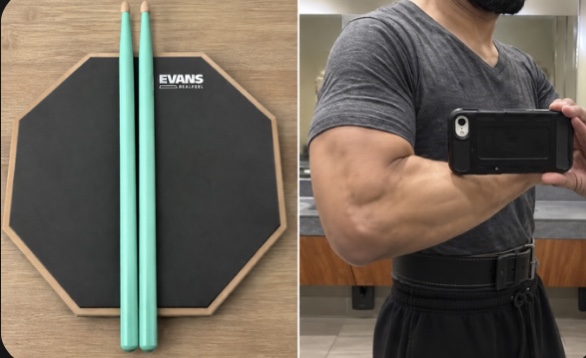
A practice drum pad is brutally simple.
There are no guitar effects, elaborate arrangements or production elements to distract from what the hands are doing. There are sticks, a striking surface and a tempo. That simplicity makes extreme-speed pad work fascinating from a physical-performance standpoint.
As the tempo rises, the challenge becomes increasingly dependent on rapid repetitive movement, timing, coordination, relaxation and economy of motion. Unnecessary movement becomes expensive. Excess tension becomes an obstacle. The hands have to execute increasingly efficient motions while remaining locked into the pulse.
For Franchesco, the progression happened remarkably quickly.
Over roughly a month and a half, he pushed through a succession of increasingly aggressive tempos. The numbers climbed through the 500s, eventually reaching the psychologically significant 600 BPM threshold.
And then he kept going. Attempts at 650 BPM followed, taking an already extreme challenge another step further.
When “Fast” Starts Becoming Absurd
Most musicians will never have a practical reason to encounter tempos remotely approaching this range during conventional performance. At 600 BPM, the underlying pulse represents 10 beats every second. At 650 BPM, that rises to approximately 10.8 beats per second.
At these kinds of speeds, the visual impression itself becomes part of the spectacle. Individual hand movements can begin to appear almost continuous rather than separate. That’s where the experiment starts becoming interesting beyond music.
You don’t have to be a drummer to understand what you’re watching.
Just as extraordinary sprinting, reaction speed or other demonstrations of rapid physical movement can be appreciated without understanding the underlying discipline, extreme hand speed has an immediate visual quality.
The viewer sees a relatively ordinary human movement – two hands operating drumsticks – being pushed into extraordinary territory.
The Goal Was 600. Then 650 Happened.
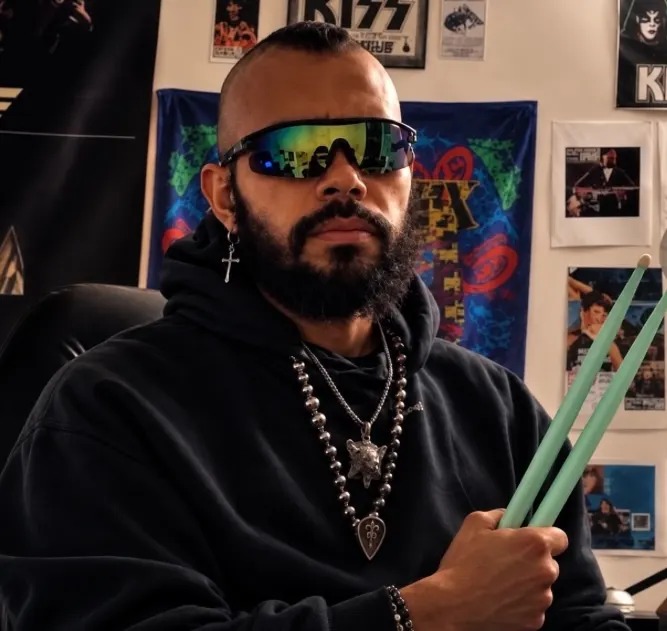
For Franchesco, 600 BPM was originally the destination.
It represented a clean psychological barrier: a number extreme enough to feel almost ridiculous when the challenge began. Reaching it could easily have been the end of the project.
Instead, something else happened.
Once Franchesco became accustomed to operating at increasingly high tempos, the former ceiling began looking less like a finish line. He continued experimenting, and 650 BPM entered the picture. Suddenly the challenge wasn’t about reaching 600 anymore. It became about finding the boundary beyond it.
That’s an important distinction. Franchesco isn’t simply trying to attach increasingly large numbers to videos. The ongoing experiment is about discovering where his own combination of speed, coordination, efficiency and control eventually encounters a genuine physical ceiling.
He hasn’t found that ceiling yet.
The “Freak of Nature” Appeal
There is something inherently compelling about watching somebody perform a familiar action at an unfamiliar extreme. Running is ordinary until somebody runs extraordinarily fast. Lifting something is ordinary until the weight becomes extraordinary.
Moving a pair of drumsticks is ordinary – until the speed becomes difficult for the eye to process.
That’s where Franchesco’s practice-pad experiment begins crossing over from a conventional musical demonstration into something resembling a physical feat. Franchesco has built his musical identity around versatility. As a multi-instrumentalist, his work has crossed guitar, bass, drums, keyboards, mandolin, harmonica and numerous musical styles.
The practice-pad challenge is different. It strips much of that context away. There is no genre requirement. There is no need for the viewer to understand scales, chord substitutions or advanced drumming terminology.
The immediate reaction is much simpler: Those hands are moving absurdly fast. That’s precisely why the experiment can appeal beyond a traditional musician audience.
Where Fitness Meets Musicianship
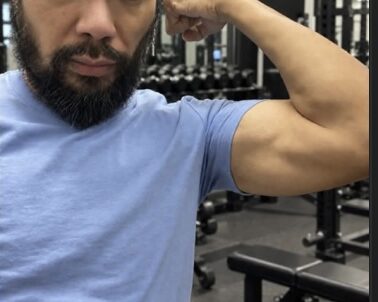
Physical conditioning is also part of Franchesco’s lifestyle. A longtime fitness enthusiast, he maintains a consistent gym routine alongside his work as a professional multi-instrumentalist. For him, musicianship and physical conditioning occupy the same world: both reward consistency, coordination, discipline and an understanding of how the body performs. His extreme-speed drum-pad work has increasingly brought those two sides together.
At Extreme Speed, Efficiency Becomes Everything
One of the interesting contradictions of extreme-speed playing is that simply trying to move harder isn’t necessarily useful. As the available time between movements becomes smaller, exaggerated physical motion becomes increasingly inefficient. The challenge shifts toward making movements economical enough to sustain the required speed.
What looks aggressive from the outside can therefore depend heavily on relaxation and efficiency.
Small changes in stick height, rebound, grip, tension and movement can affect what happens as the tempo climbs. The pursuit consequently becomes more than a brute-force challenge. It becomes refinement at an extreme scale.
- Can the movement become more economical?
- Can an extreme tempo eventually begin feeling familiar?
- Can the body adapt to a speed that previously seemed impossible?
- And once that happens, where is the next wall?
Six Weeks Changed the Question
Perhaps the most striking element of Franchesco’s experiment isn’t any single number.
It’s the trajectory. In only roughly six weeks, the project progressed into the 600 – 650 BPM range. That rapid progression has transformed what began as a specific target into an open-ended exploration. There is no predetermined final number.
Maybe another breakthrough is waiting beyond 650. Maybe the greater accomplishment will be making previously extreme speeds increasingly controlled and repeatable. Eventually, there will presumably be some point where additional speed simply stops being practical.
Finding that boundary is now part of the fascination. Franchesco has already accomplished the original objective.
- 600 BPM was the goal.
- 650 BPM pushed beyond it.
Now the drum pad remains in front of him, and the experiment continues. After climbing into the 600 – 650 BPM range in roughly six weeks, the question is no longer whether Nate Franchesco can reach absurd speed.
The question now is: How Far Can He Push The Outer Limits?